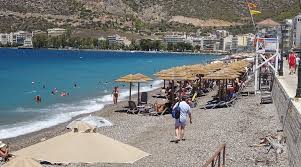
Playa de Loutraki is a coastal jewel in Corinth, famous for its thermal waters, polished pebbles, and a vibrant urban atmosphere that makes it the perfect destination for a relaxing or activity-filled getaway.
Ask AI about this beach
Instant answers about Playa de Loutraki

Recomendaciones
🗺️ Did you know...?
Más del 80% del océano está sin explorar. Conocemos mejor la superficie de Marte que el fondo de nuestros propios mares.
About this beach
Table of contents
Introduction
From the moment we set foot on Playa de Loutraki, in the beautiful region of Corinth (Peloponnese), we know we have arrived at a special place. This beach is not just a stretch of coastline; it is the heart of a vibrant spa town, famous for its healing thermal waters and an atmosphere that perfectly combines Mediterranean relaxation with urban comfort. It is a destination that invites us to immerse ourselves in its crystal-clear waters, enjoy the warmth of the Greek sun, and explore the cultural and historical richness that surrounds it. The sea breeze, the sound of waves gently breaking on the pebbles, and the scent of salt and delicious local cuisine welcome us to this idyllic corner of Greece.
Playa de Loutraki is much more than just a place to sunbathe. It is a complete experience, a mosaic of sensations that envelops us from the very first moment. With its coveted Blue Flag, a quality distinction that guarantees the cleanliness of its waters and the excellence of its services, we feel safe and well cared for. Its extensive shore of pebbles polished by the sea, which shine under the sun, offers us a unique landscape and a pleasant texture to walk on. Here, the intense blue of the sky merges with the turquoise of the sea, creating a palette of colors that leaves us breathless. It is a place where families find a safe refuge, where relaxation lovers can disconnect, and where social travelers can enjoy a lively and vibrant atmosphere. Without a doubt, it is one of the Corinth (Peloponnese) beaches that we cannot miss.
How to Get to Playa de Loutraki
Getting to Playa de Loutraki is surprisingly easy, making it an accessible destination for many travelers. Its strategic location on the Isthmus of Corinth, a short distance from the Greek capital, Athens, is one of its greatest advantages. We, when planning our trip, found several comfortable and efficient options to reach this coastal paradise. The transportation infrastructure in Greece has improved considerably, facilitating access to destinations like Loutraki.
From Athens
If we fly into Athens International Airport (ATH), the path to Loutraki is direct and scenic. The distance is approximately 80 to 90 kilometers, which translates to a journey of just over an hour by car. We recommend renting a car directly at the airport. The E94/A8 highway is modern and well-signposted, taking us directly west, passing by the famous Corinth Canal, an impressive sight worth a quick stop. Driving this route is a pleasant experience, with landscapes changing from bustling Athens to the picturesque hills and coast of the Peloponnese.
For those who prefer not to drive, there are excellent bus connections. The KTEL Korinthias company operates regular services from the Kifisou bus station in Athens to Loutraki. The buses are comfortable and the journey takes approximately 1 hour and 30 minutes, offering us the chance to relax and enjoy the scenery without worrying about traffic or navigation. Furthermore, some train services reach Corinth, from where you can take a taxi or a local bus to Loutraki, which is only about 15 kilometers away.
From Other Parts of the Peloponnese
If we are already exploring other wonders of the Peloponnese, getting to Loutraki is also simple. The road network is good, and the distances are manageable. For example, from Nafplio, one of the most charming cities in the region, the car journey takes about 1 hour and 15 minutes. From Patras, in the western Peloponnese, the trip is approximately 1 hour and 45 minutes. These connections allow us to easily integrate a visit to Playa de Loutraki into a broader itinerary of the peninsula, thus discovering the diversity of Greece beaches and its historical treasures.
Once in Loutraki, the beach is the center of the city and is easily accessible on foot from most hotels and accommodations. There are ample parking areas along the coast and adjacent streets, although in high season it can be a bit more difficult to find a spot. We, upon arrival, always prefer to walk to soak up the local atmosphere and enjoy the sea views while heading to our favorite spot on the beach.
The Sand and the Water
When we talk about Playa de Loutraki, the first image that comes to mind is not that of a golden sandy beach, but that of an endless blanket of polished, shiny pebbles. And it is precisely this characteristic that gives it its unique and distinctive charm. Forget about sand sticking everywhere; here, the experience is different and, for many of us, even superior. The pebbles, of various sizes and shades of gray, ochre, and white, have been shaped by the incessant ebb and flow of the waves for centuries, resulting in a smooth and pleasant-to-the-touch surface that massages our feet with every step. Walking barefoot on this shore is a therapeutic sensation, a true pleasure for the senses.
The particularity of the ground type, composed entirely of pebbles, has a fundamental advantage: the extraordinary clarity of its waters. Unlike sandy beaches, where fine sand can cloud the water with movement, the pebbles of Loutraki allow the sea to remain pristine and transparent. We were amazed by the underwater visibility; we could see the seabed with astonishing clarity, even at several meters depth. The waters of the Gulf of Corinth, where this Corinth (Peloponnese) beach is located, are famous for their serenity and mild temperature, making them ideal for bathing during g