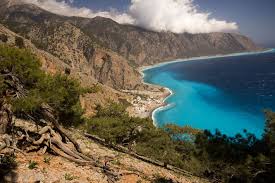
Playa de Agia Roumeli is a remote pebble paradise on the south coast of Crete, famous for being the endpoint of the Samaria Gorge, accessible only on foot or by boat.
Ask AI about this beach
Instant answers about Playa de Agia Roumeli

🦪 Did you know...?
Una ostra puede filtrar hasta 190 litros de agua al día, limpiando el ecosistema marino.
About this beach
Table of contents
Introduction
We delve into the heart of the most authentic Crete, where nature still dictates the pace of life. Today, our compass leads us to Playa de Agia Roumeli, a destination not for everyone, but one that generously rewards those who dare to seek it. Located on the remote south coast of the island, in the region of Chania (Crete), this beach is much more than a simple stretch of coastline; it is the epic endpoint of one of Europe's most famous hikes, the legendary Samaria Gorge. For us, it is the promise of a well-deserved rest and total immersion in a landscape that will take your breath away.
Agia Roumeli is not one of those beaches you can easily reach by car. Its isolation is precisely part of its charm and what makes it a refuge of peace and wild beauty. Here, time seems to stand still, and the only sound breaking the silence is the gentle murmur of waves breaking against the pebbles and, perhaps, the echo of conversations in one of its cozy tavernas. It is a place where adventure and relaxation go hand in hand, offering us a truly unforgettable experience on the beaches of Greece.
How to Get to Playa de Agia Roumeli
Getting to Playa de Agia Roumeli is, in itself, an adventure and a fundamental part of the experience. Forget easy access and paved roads right to the shore, because Agia Roumeli is not like that. Its isolation is its greatest charm and its greatest challenge. Mainly, there are two ways to reach this hidden paradise, both promising spectacular views and a sense of achievement.
Through the Samaria Gorge
The most iconic and popular way to reach Agia Roumeli is, without a doubt, by completing the famous Samaria Gorge. This is one of the longest gorges in Europe and one of the natural wonders of Crete. We would describe it as a transformative experience, a physical challenge that culminates in the reward of Agia Roumeli's crystal-clear waters. Here are the details you need to know:
- The Route: The hike is approximately 16 kilometers long from Xyloskalo, on the Omalos plateau, to Agia Roumeli. It is a constant descent, sometimes steep, through spectacular mountain landscapes, pine and cypress forests, and narrow passages known as the 'Iron Gates'.
- Duration: Generally, the hike takes between 5 and 7 hours, depending on our pace and the stops we make to admire the landscape and rest.
- Difficulty: Considered moderate to high difficulty. It requires good physical condition, proper hiking footwear, and plenty of water. The terrain is rocky and uneven, and knees can suffer from the descent.
- Logistics: The usual practice is to take an early morning bus from Chania or its surroundings to Xyloskalo. Once the hike is completed, from Agia Roumeli, a ferry will take us to Paleochora, Sougia, or Hora Sfakion, from where we can take a bus back to our starting point. It is essential to plan ahead, especially the ferry schedules.
By ferry from the south coast
If the idea of a 16-kilometer hike is not to our liking, or if we simply want a more relaxed arrival, the ferry option is perfect. This alternative allows us to enjoy the stunning views of the south coast of Crete from the sea, an equally magical perspective.
- Departure Ports: Ferries to Agia Roumeli operate from the small ports of Paleochora, Sougia, and Hora Sfakion (Chora Sfakion), all in the region of Chania (Crete). These villages are accessible by car or bus from Chania.
- Companies: The main company operating these routes is Anendyk Ferries. It is crucial to check their schedules in advance, as they can vary depending on the season and weather conditions.
- Frequency: In high season (summer), ferries usually have several departures per day. Off-season, the frequency decreases significantly.
- Advantages: This option is ideal for families with young children, people with reduced mobility, or simply for those seeking a more peaceful experience. Furthermore, it allows us to visit Agia Roumeli as a day trip or as part of a tour of the south coast.
The Sand and Water
Once we set foot on Playa de Agia Roumeli, the first thing that catches our attention is its uniqueness, especially regarding its composition. Here we will not find the fine, golden sand we often associate with paradisiacal beaches, but something much more authentic and in tune with the wild landscape that surrounds it: pebbles.
The type of ground: Dark, polished pebbles
Playa de Agia Roumeli is predominantly a pebble beach. These pebbles, in dark tones ranging from anthracite gray to black, have been polished by the waves for millennia, giving them a smooth, rounded shape. Walking on them can be a bit uncomfortable at first for our bare feet, so we highly recommend wearing water shoes or sandals. However, this characteristic has its advantages: the pebbles do not stick to the skin or towels, making cleanup easier after a day at the beach.
The presence of pebbles also contributes to the exceptional transparency of the water. With no fine sand to be stirred up by the movement of the waves, the sea here is of astonishing clarity, inviting us to dive in and explore its depths. It is a visual and tactile experience that connects us directly