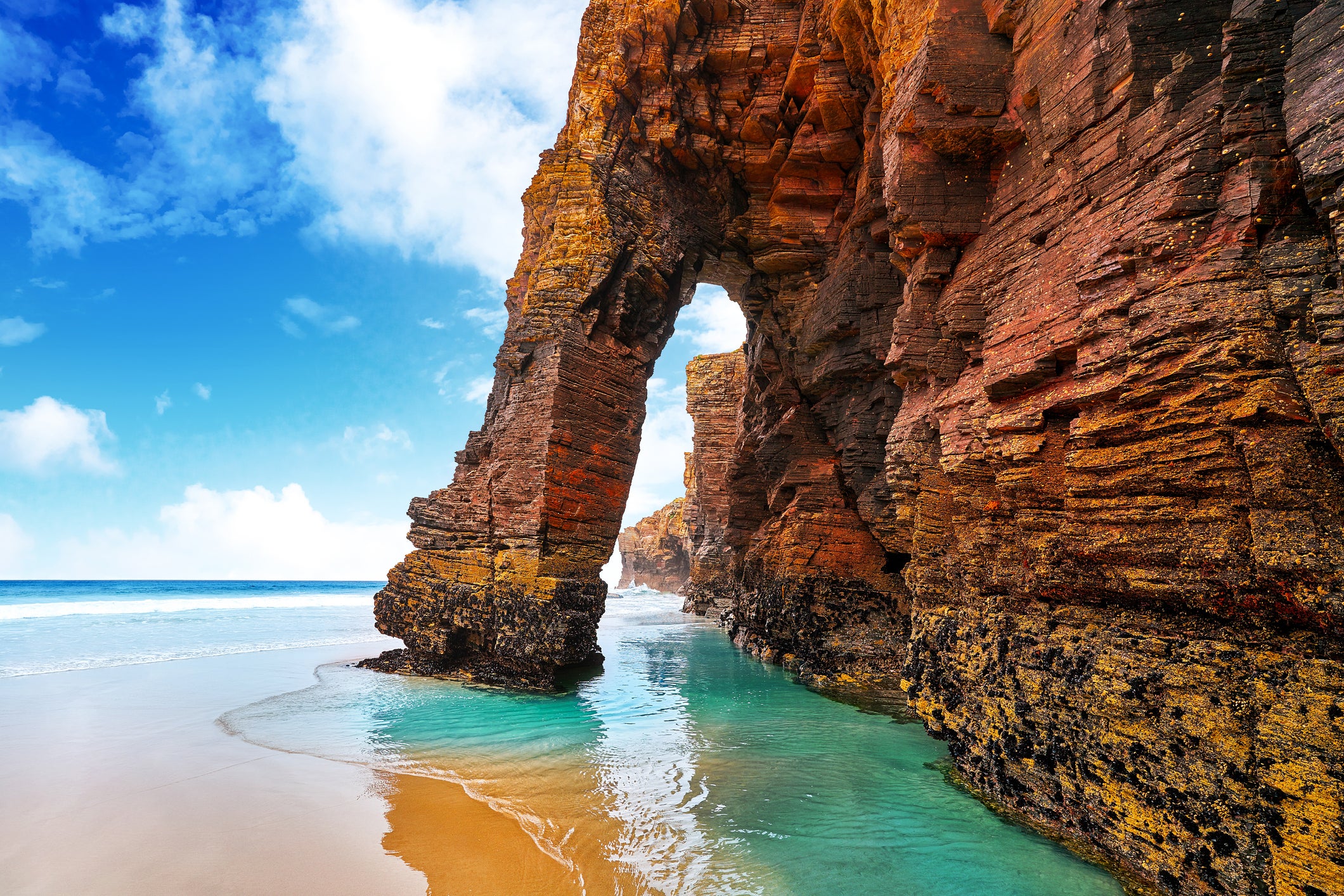
Playa de las Catedrales is a natural monument of cliffs and rocky arches sculpted by the sea, which only reveals its full splendor during low tide.
Ask AI about this beach
Instant answers about Playa de las Catedrales (Aguas Santas)

💧 Did you know...?
El océano tiene "olas internas" que se mueven bajo la superficie, entre capas de agua de distinta temperatura y salinidad.
About this beach
Table of contents
Introduction
If there is one place on the Galician coast that leaves us breathless and makes us feel the majesty of nature at its finest, that is, without a doubt, Playa de las Catedrales (or Praia das Catedrais, in Galician), also known as Aguas Santas. Located in the municipality of Ribadeo, in the province of Lugo, this beach is not just a stretch of sand, but a true work of art sculpted by the Atlantic over millions of years. Its imposing cliffs, natural arches, caves, and rock formations remind us of the buttresses of a great Gothic cathedral, hence its evocative name. It is a visual spectacle that attracts thousands of visitors every year, a natural monument we are fortunate to be able to contemplate.
Our visit to Playa de las Catedrales (Aguas Santas) is always an unforgettable experience. It is essential to plan it in advance, as its most striking beauty is only revealed at low tide, the moment when we can walk among its arches and explore its nooks and crannies. High tide, moreover, completely covers the sandy area, transforming the landscape into a succession of cliffs that plunge directly into the sea. It is a beach that invites contemplation, photography, and a deep connection with the natural environment, a true treasure among the beaches of Lugo that we must care for and respect.
How to Get to Playa de las Catedrales (Aguas Santas)
Getting to Playa de las Catedrales is relatively straightforward, but requires some planning, especially if you visit during the high season. The beach is located about 10 kilometers west of Ribadeo, on the coast of Lugo. If coming by car, the most common way is to take the A-8 motorway (Autovía del Cantábrico) and exit at junction 516 towards the N-634 in the direction of Foz/Barreiros. From there, the signs for 'Praia das Catedrais' are clear.
Access and Parking
There is a large free parking area near the beach, although during the summer months (July and August) and Easter, due to the large influx of visitors, access to the beach and the parking lot is regulated and it is necessary to book entry in advance through the website of the Xunta de Galicia. We strongly recommend checking these regulations before your visit to avoid surprises. Once at the parking lot, access to the beach is via wooden stairs or a ramp that descend the cliff, adding a touch of adventure to the arrival. It is important to remember that access can be somewhat difficult for people with reduced mobility due to these slopes.
Tide Times
The most crucial factor for visiting Playa de las Catedrales is the tide. You can only fully enjoy its rock formations during low tide. We advise you to check tide tables in advance, available online or at local tourist offices. The ideal is to arrive approximately an hour and a half before low tide to have enough time to explore calmly and leave before the tide starts to rise strongly. Safety is paramount, and the Cantabrian Sea can be unpredictable.
The Sand and Water
The sand at Playa de las Catedrales is fine and golden, very pleasant for walking barefoot while exploring its corners. As it is flanked by imposing cliffs and rock formations, the interaction between the sand and the rock is constant, creating a dynamic and fascinating landscape. The beach floor is predominantly sand, but let's not forget the impressive rocks that define it.
As for the water, it is the characteristic clear and fresh water of the Atlantic, with green and blue tones that contrast wonderfully with the color of the sand and rock. Although it invites a swim, the beach is not primarily a destination for swimming due to the currents and the very nature of the place, which invites more exploration and photography. The waters are cold, as is usual on the Galician coast, but their purity and transparency are undeniable. It is a perfect place to observe the marine life trapped in the rock pools when the tide is low, especially for children.
Services and Facilities
Playa de las Catedrales (Aguas Santas), being a protected natural monument, does not have extensive service infrastructure directly on the sand, which helps preserve its wild and pristine character. However, in the vicinity of the beach access, there are some basic services to make our visit comfortable and safe.
There is a free parking lot (with regulation in high season, as already mentioned), showers to rinse off sand and salt, and public toilets/WCs. During the summer season, the beach has lifeguard service, which gives us additional peace of mind when visiting, especially with children. Furthermore, around the parking area, we find some restaurants and cafeterias where we can have a drink or enjoy local cuisine before or after our exploration. Do not expect to find services like umbrella and sunbed rentals, as the goal is to keep the environment as natural as possible. It is also not a 'Pet-Friendly' beach, so dogs are not allowed on the sand.
Best Time to Visit
The best time to visit Playa de las Catedrales depends on what we are looking for. If we want to avoid crowds and enjoy greater tranquility, spring (April-May-June) and autumn (September-October) are ideal. The weather is usually pleasant, and the influx of visitors is lower, which makes booking access (if necessary) easier and allows for a more intimate experience with the landscape. Furthermore, the light in these seasons is fantastic for photography.