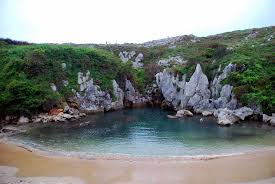
Playa de Gulpiyuri is a tiny inland beach in Asturias, declared a Natural Monument, famous for its unique karst landscape and its seawater that arrives through an underground tunnel.
Ask AI about this beach
Instant answers about Playa de Gulpiyuri

🗑️ Did you know...?
El Mediterráneo concentra una de las mayores cantidades de microplásticos del mundo. ¡Cada día llegan miles de toneladas de residuos plásticos!
About this beach
Table of contents
Introduction
Lovers of the unusual, get ready for a trip to one of the most magical and surprising corners of Spanish geography! Today we take you to Playa de Gulpiyuri, a place that defies all logic and will undoubtedly be etched in your memory as one of the most unique experiences. We're not talking about just any beach; Gulpiyuri is a true whim of nature, a hidden gem that leaves us speechless with its uniqueness. Imagine a beach of fine sand, bathed by the Cantabrian Sea, but... in the middle of a meadow! Yes, you heard right. This wonder is located inland, about a hundred meters from the coast, in the heart of Asturias, in the municipality of Llanes.
What makes Gulpiyuri so special is its geological origin. It is a karst sinkhole, a depression in the ground formed over thousands of years by the dissolution of limestone rock. The waters of the Cantabrian Sea filter through a network of caves and underground tunnels, emerging in this small inland bay to form a beach barely 40 meters long. It is a visual and geological spectacle that reminds us of the power and beauty of nature, a place where the sea and land merge in a way we could never have imagined. Declared a Natural Monument, Playa de Gulpiyuri is a treasure we must care for and admire with the respect it deserves.
How to get to Playa de Gulpiyuri
Getting to Playa de Gulpiyuri is part of the adventure, as its remote and protected character means we cannot access it directly by car. It's a place that requires a little effort, but rewards every step tenfold. We recommend several options to get close to this natural wonder.
By car
If you're coming by car, the most common way is to head to the Llanes area, specifically to the small villages of Naves or San Antolín de Bedón. From the A-8 motorway (Autovía del Cantábrico), take exit 313 towards Naves. Once in Naves, there are signs for Gulpiyuri, although they can be discreet. You can park in the vicinity of the village or in a small designated parking area near the coast, from where you'll have to walk. Another option is to leave your car in the parking lot of Playa de San Antolín, which is a short distance from Gulpiyuri. From any of these points, access to the beach is on foot, via a rural dirt path that runs through meadows and vegetation. It's a pleasant 10-15 minute walk, suitable for most people, although it is not paved and can be a bit uneven.
By public transport
Access by public transport is more limited. There are bus services connecting the main Asturian towns with Llanes and other nearby villages like Naves. Once in Naves, as mentioned, the only way to reach the beach is on foot. It's always advisable to check the updated schedules and routes of ALSA or other local companies, especially outside the high season, as they can vary significantly.
On foot or by bicycle
For hiking or cycling enthusiasts, the area offers beautiful routes. You can reach Playa de Gulpiyuri on foot or by bicycle from nearby villages like Naves or San Antolín de Bedón. It's an immersive experience that will allow you to fully enjoy the Asturian rural landscape before discovering the beach. Remember to wear comfortable and appropriate footwear for walking on uneven terrain, and of course, bring water and some sun protection, especially in the summer months.
The sand and water
When stepping onto Playa de Gulpiyuri, the first thing we notice is the fine, golden sand that covers its small surface. It's soft, pleasant-to-the-touch sand, perfect for walking barefoot or simply sitting to contemplate the landscape. Its texture reminds us of oceanic beaches, despite being inland, which adds another layer to its uniqueness. The beach, being so small, has little space for large dunes or extensive sandy areas, but its tiny size is part of its charm and invites us to a more intimate and close experience with nature.
The water of Gulpiyuri is another of its great attractions. Although it comes directly from the Cantabrian Sea through an underground tunnel, it is usually notably calmer than the waters of coastal beaches, being protected from large waves and currents. However, don't expect warm Caribbean waters; the temperature is typical of the Cantabrian Sea, cool and invigorating, ideal for a dip on hot summer days. The most fascinating thing is how the tides directly influence the beach. At high tide, the water almost completely floods the sandy area, creating a small natural saltwater pool. At low tide, the water recedes, revealing the sand and allowing us to explore the small basin of the beach in its entirety. It's a changing spectacle that invites us to visit at different times to appreciate its various facets.
The color of the water is an emerald green and bluish hue, very transparent, allowing us to see the sandy bottom. The water quality is excellent, as it is constantly renewed by the tidal flow. It's a perfect place for a relaxing swim and to feel a connection with the sea in a very particular way. The experience of swimming in an inland beach, with the sound of waves arriving from the depths of the earth, is something we won't easily forget.
Services and facilities
It's essential to understand that Playa de Gulpiyuri is a protected Natural Monument and, as such, lacks most of the services and facilities we would find at a conventional beach. Precisely, its charm lies in its almost virgin state and minimal human intervention. This means we must i