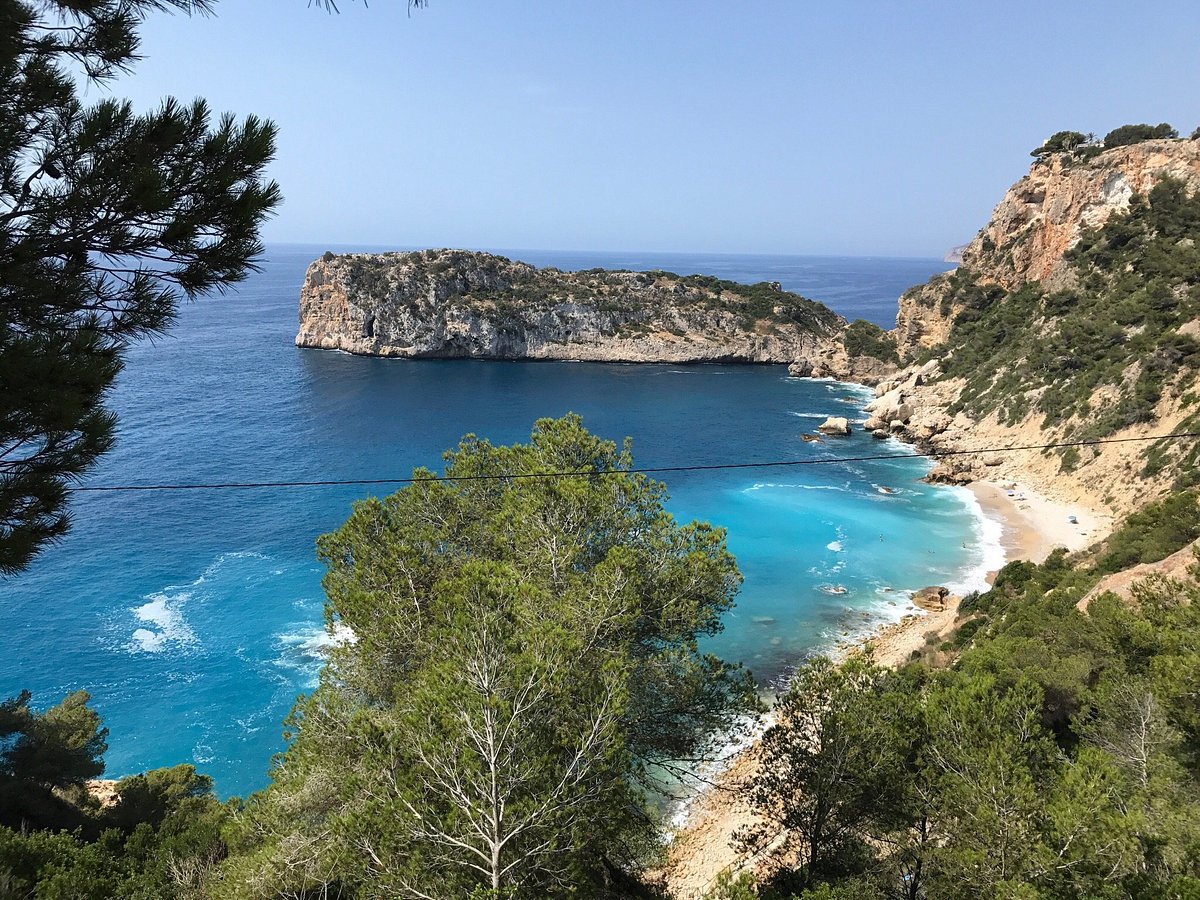
Cala Ambolo is a virgin pebble cove in Javea, famous for its crystal-clear waters, the Descubridora islet, and its natural character, although it is currently closed to the public due to landslide risk.
Ask AI about this beach
Instant answers about Cala Ambolo

Recomendaciones
🌊 Did you know...?
Las corrientes de resaca son estrechas. Si te atrapa una, nada en paralelo a la orilla hasta salir de ella, nunca contra la corriente.
About this beach
Table of contents
Introduction
Today we delve into one of those corners that, although known, maintain an aura of mystery and untamed beauty: Cala Ambolo beach in Javea, Alicante. This cove, a true hidden treasure on the Costa Blanca, offers us a postcard image with its turquoise waters and unique pebble landscape. It is a place that evokes the purest Mediterranean essence, inviting us to disconnect and contemplate nature in its wildest state.
For years, Cala Ambolo has been the refuge for those seeking to escape the bustle of the busier beaches, a sanctuary for snorkeling and diving lovers, thanks to the impressive clarity of its waters and the richness of its seabed. Its iconic Descubridora islet, which majestically emerges off the coast, adds a touch of drama and uniqueness to this already captivating landscape. However, it is essential that we know that, due to the risk of landslides on its cliffs, Cala Ambolo is currently closed to the public. Despite this restriction, its beauty remains undeniable and its memory endures for those who had the privilege of visiting it, and its potential as a natural jewel remains intact for when conditions allow its safe reopening.
How to Get to Cala Ambolo
Getting to Cala Ambolo, when access was permitted, has always been part of the adventure. Located in one of the most privileged areas of Javea, near Cap de la Nao, the path to it already gifted us with spectacular coastal views. To access the cove, we would take the Cap de la Nao road and turn off onto Barraca street (or La Nao street). At the end of this street, there was a parking area, often insufficient in high season, which meant many cars parked on the verges of the urbanization, sometimes causing traffic and safety problems. From the parking area, access to the cove was via some stone steps, quite steep and with a considerable slope. This descent, although demanding, prepared us for the visual reward awaiting us below.
It is crucial to reiterate the current situation: access to Cala Ambolo beach is officially closed for safety reasons, to protect visitors from possible landslides. The area is signposted and barriers have been implemented to prevent passage. Therefore, any attempt to access it is at one's own risk and is discouraged by the authorities. We hope that in the future solutions can be found to allow safe enjoyment of this paradise, but for now, we must respect the restrictions for our own good and for the conservation of the environment.
The Sand and Water
The particularity of Cala Ambolo lies, to a large extent, in its type of ground. Here we will not find the typical fine, golden sand that characterizes other Alicante beaches. Instead, the cove is composed of pebbles and cobblestones, of considerable size. This characteristic, far from being an inconvenience, gives it a rustic and natural charm, and is precisely what contributes to the astonishing transparency of its waters. The pebbles do not cloud the water, allowing light to penetrate to the bottom, revealing an underwater spectacle of great beauty.
The waters of Cala Ambolo are, without a doubt, its greatest attraction. Of an intense turquoise color and with a clarity that allows us to see fish several meters deep, they are ideal for bathing and, above all, for snorkeling and diving. The water temperature is usually pleasant for much of the year, inviting us to immerse ourselves in a vibrant marine ecosystem, populated by meadows of Posidonia oceanica (a vital marine plant for the ecosystem) and varied marine fauna. The tranquility of its waters, being protected by the surrounding cliffs, made it a kind of natural pool, perfect for enjoying a refreshing dip.
Services and Facilities
While the natural beauty of Cala Ambolo is undeniable, it is important to be honest about the services and facilities it offered. Precisely, its charm lay in its wild and virgin character, which implied a total absence of services. When the cove was open to the public, we did not have chiringuitos (beach bars) to get a drink, nor showers to rinse off the salt, nor public toilets or lifeguard service. There was no rental of umbrellas or sunbeds, nor sports or children's areas. The philosophy was that of a pure cove, without human interventions altering its essence.
This meant that, to fully enjoy the experience at Cala Ambolo, we had to be completely self-sufficient. It was essential to bring our own food and drink, enough water, towels, an umbrella if we sought shade, and everything necessary to spend the day. The absence of lifeguards also implied greater caution when bathing, especially with children or people with difficulties. The parking, as mentioned, was limited and often informal. This lack of infrastructure, although it might seem like a disadvantage to some, was precisely what attracted those seeking a more authentic connection with nature, away from the comforts of urban beaches. Of course, with its current closure, this absence of services is even more pronounced, as it is not enabled for any type of public use.
Best Time to Visit
When Cala Ambolo was accessible, the choice of the best time to visit it depended a lot on what we were looking for. For those who fled the crowds and preferred tranquility, spring (April, May, early June) and autumn (September, October) were, without a doubt, the ideal times. During these months, the climate in Javea is exceptionally pleasant, with mild temperatures inviting for bathing and outdoor enjoyment. The influx of people was much lower, allowing one to savor the peace and serenity of the cove in its maximum splendor. Furthermore, the light of these seasons is perfect for photography, enhancing the turquoise colors of the sea and the green of the surrounding vegetation.
Summer, especially July and August, was the time of greatest influx. Although good weather was guaranteed, the cove filled up quickly, and finding parking or a spot for a towel could become a near-impossible mission. If we still decided to visit in summer, our recommendation was to arrive very early in the morning, right at sunrise, to be able to enjoy a few hours of calm before the massive arrival of bathers. However, and reiterating the most important information, the cove is currently closed. Therefore, the best 'time' to visit it is when the competent authorities announce its reopening, once the safety of the place is guaranteed. Until then, we must limit ourselves to admiring its beauty from a distance or through images.
Activities and Sports
The nature of Cala Ambolo, with its pristine waters and rich seabed, made it a paradise for various water activities, always with the caution and respect that a natural and unsupervised environment deserves. The star activity, certainly, was snorkeling. Goggles, a snorkel, and fins were essential to explore the Posidonia meadows, schools of colorful fish, and underwater rock formations that housed fascinating marine life. The visibility was exceptional, allowing us to enjoy a natural aquarium under the open sky.
For the more adventurous, diving was another fantastic option. The depths near the Descubridora islet and the cliffs offered dive sites with caves and corners to explore, accessible for divers of different levels. Kayaking and paddle surfing were also popular, although they involved the challenge of transporting the equipment to the cove and accessing the water from the pebbles. From the kayak, we could explore the coast, discover small nearby caves, and admire the cliffs from a different perspective. Photography was another of the main activities; the landscapes of Cala Ambolo are incredibly photogenic, from sunrise to sunset, offering unique opportunities to capture the beauty of the Mediterranean. Of course, all these activities were subject to the possibility of access to the cove, something that, as we have mentioned, is not currently possible due to its closure for safety. When it reopens, we hope to be able to enjoy these wonderful experiences again.
For Families with Children
When talking about the suitability of Cala Ambolo for families with children, it is important to be very clear and honest. Historically, and with the cove open, it was not the most advisable option for families with young children or those seeking comfort. Several factors contributed to this:
- Difficult access: The steep steps and considerable slope made transporting baby strollers, toys, or simply going up and down with small children an arduous and potentially dangerous task.
- Type of ground: The pebbles and cobblestones can be uncomfortable for children's delicate feet and hinder play on the shore, unlike fine sand where they can build castles.
- Absence of services: The lack of lifeguards, toilets, showers, chiringuitos, or designated shaded areas meant that parents had to be much more prepared and attentive, without the help of basic infrastructure.
- Water depth: Although the waters are calm, the depth increases relatively quickly, requiring constant supervision.
What to Do in the Surrounding Area
Although Cala Ambolo is closed, the area of Javea and its surroundings offer us endless options to complement our visit and enjoy the Costa Blanca to the fullest. It is a region rich in landscapes, culture, and gastronomy, perfect to explore:
- The Old Town of Javea: A labyrinth of narrow, cobbled streets, white houses with Gothic portals and windows of 'tosca' (local sandstone). Here we find the Church of San Bartolomé, the Municipal Market, and the Soler Blasco Archaeological and Ethnographic Museum. It is ideal for a quiet stroll and discovering local history.
- The Port of Javea: Known as 'Duanes de la Mar', it offers a maritime atmosphere with fresh fish restaurants, a nice promenade, and the modern Church of Nuestra Señora de Loreto, with its peculiar roof that simulates a ship's hull.
- Arenal Beach: The only sandy beach in Javea, with a vibrant promenade full of restaurants, bars, and shops. It is ideal for families and to enjoy nightlife in summer.
- Javea Viewpoints: The route of the viewpoints is essential. It gifts us spectacular views of the coast. The Mirador de la Granadella, the Mirador de la Cruz del Portitxol (with the famous blue doors), and, of course, the Cap de